The tradition
A medicine two thousand years old
Chinese medicine is not a single therapy but a complete medical system: it has its own account of the body, its own way of examining a patient, and its own therapies. It has been practised, argued over and revised continuously for two millennia. What follows is where it came from, how a practitioner reaches a diagnosis, and what the treatments actually are.
About this page
Where it comes from
This was never a straight line. Each era produced people who proposed something new and corrected what came before. These are some of the turning points.
- Warring States – Western Han
Huangdi Neijing
The earliest surviving theoretical corpus, in two parts — Suwen and Lingshu. It sets out yin-yang and the five phases, the organ and channel systems, and states that the superior physician treats what has not yet become illness.
- Eastern Han
Shennong Bencao Jing
The earliest surviving materia medica, describing 365 substances graded into upper, middle and lower classes, together with which combinations were held to be compatible or not.
- Eastern Han
Zhang Zhongjing, Shanghan Zabing Lun
Established pattern differentiation as clinical method, and the six-channel framework. Later divided into the Shanghan Lun and the Jingui Yaolue; its formulas remain in everyday clinical use.
- Western Jin
Huangfu Mi, Zhenjiu Jiayi Jing
The earliest surviving text devoted to acupuncture and moxibustion, systematising point locations and needling technique — the moment the practice moved from oral transmission into literature.
- Tang
Sun Simiao, Beiji Qianjin Yaofang
A compendium of everything prescribed before the Tang. Its opening essay on the character required of a physician is the earliest systematic statement of medical ethics in the tradition, and is still quoted.
- Jin – Yuan
The four masters
Liu Wansu, Zhang Congzheng, Li Dongyuan and Zhu Danxi each argued for a different emphasis and disputed openly with one another. The tradition moved from accumulated experience into competing schools of thought.
- Jin – Yuan
The Yishui school
Founded by Zhang Yuansu at Yishui, in what is now the Baoding area of Hebei, with an emphasis on organ-based differentiation. His student Li Dongyuan wrote the Treatise on the Spleen and Stomach, arguing that injury to those organs is where a great many illnesses begin.
This clinic's connection to the Yishui school → - Ming
Li Shizhen, Bencao Gangmu
Twenty-seven years in the making, recording 1,892 substances and more than ten thousand formulas. As much a work of natural history as a pharmacopoeia, and later translated into many languages.
- Qing
The warm-disease school
Ye Tianshi and Wu Jutong developed frameworks for febrile illness that departed from the Shanghan Lun, filling a gap its authors had not addressed.
- 1999
Hong Kong's Chinese Medicine Ordinance
The Legislative Council passed the Chinese Medicine Ordinance (Cap. 549) on 14 July 1999, establishing the Chinese Medicine Council of Hong Kong. Practitioners must now qualify and register before they may practise, making Chinese medicine a statutorily regulated profession here.
The four examinations
A practitioner does not rely on any single finding. Looking, listening and smelling, asking, and palpating are read against one another — the four are combined precisely because none of them is sufficient alone.
Looking
Bearing, complexion, build and movement, and a close look at the tongue. The colour of the tongue body, and the thickness and moisture of its coating, are among the more important observations.
Listening and smelling
One word in Chinese covers both. The strength and pitch of the voice, the sound of the breath and of a cough, and changes in odour are all noted.
Asking
Cold and heat, sweating, head and body, appetite and taste, digestion, chest and abdomen, sleep, and the menstrual history — traditionally grouped as ten enquiries. What the patient reports carries real diagnostic weight.
Palpating
Taking the pulse at three positions on each wrist, reading depth, rate and quality; and pressing the abdomen, limbs and specific points for texture, temperature and tenderness.
Treating the pattern, not the label
This is where the tradition differs most from modern medicine. What is treated is the pattern — a summary of the whole state of the body at a moment in time. The same named illness can present as entirely different patterns in two people, or in the same person at different stages, and those patterns can call for opposite approaches.
One illness, different treatments
The same condition with different patterns is treated differently. It is why two patients describing the same complaint may leave with quite different formulas.
Different illnesses, one treatment
Unrelated conditions presenting the same pattern may be approached alike. What is being read is the overall state, not the name of the disease.
The eight principles
Yin and yang, exterior and interior, cold and heat, deficiency and excess — four paired axes that give the most basic coordinates for describing a pattern.
Person, season, place
Constitution, time of year and living conditions are all weighed. A formula that suits one person in one season may not suit another.
The therapies
Treatment is not only a matter of taking medicine. These are the main methods within the scope of registered practice in Hong Kong. What follows describes what each one is; it does not say what any of them is for.
Herbal medicine
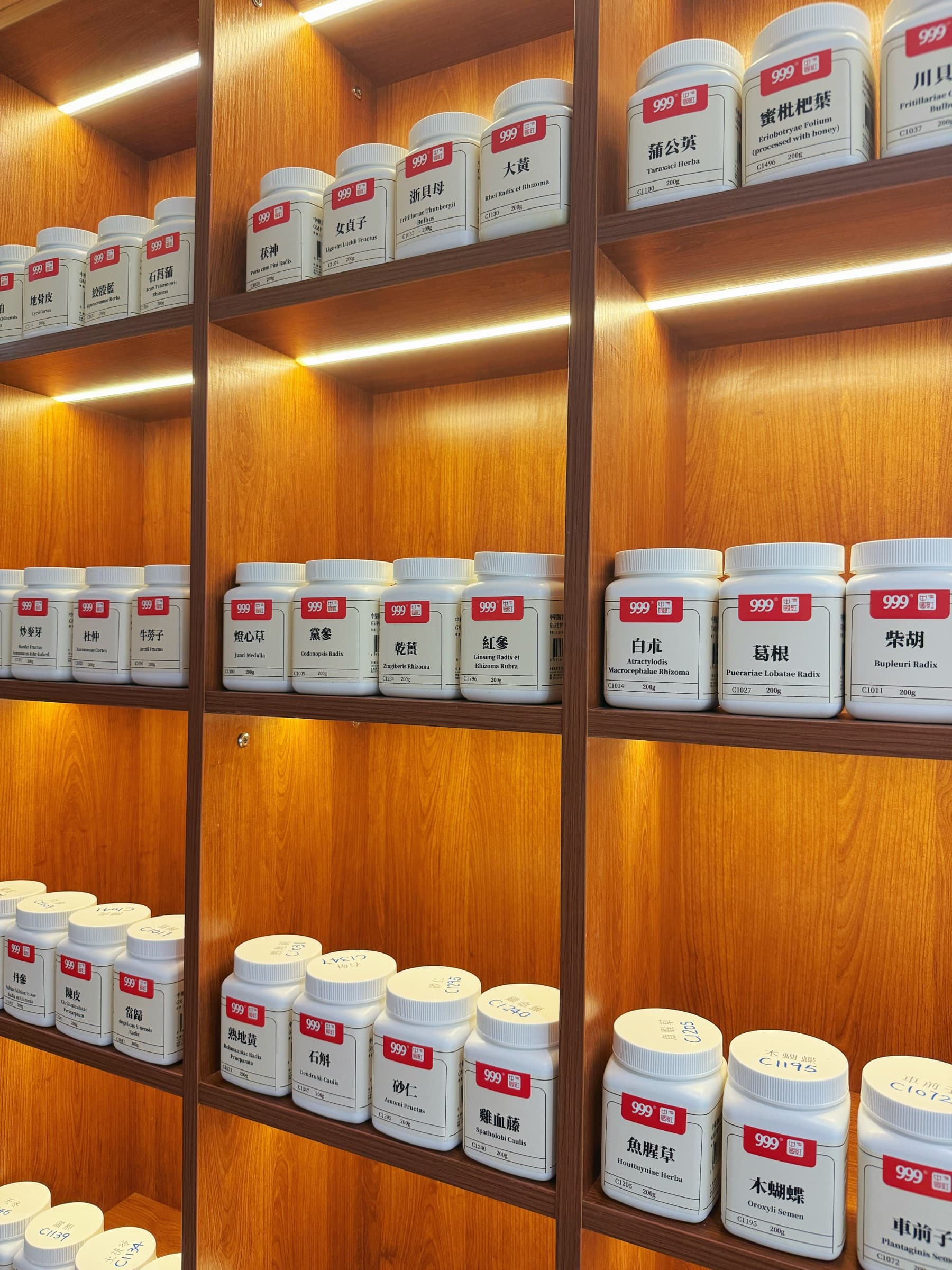
Formulas are composed to match the pattern, structured as chief, deputy, assistant and envoy: a principal medicinal, others to support it, temper it, or direct it. Dispensed as decoctions from raw herbs, as concentrated granules, or as pills, powders and pastes.
Acupuncture
Fine needles inserted at specific points and manipulated by lifting, thrusting or rotating. Needles are sterile and single-use.
Moxibustion
Burning mugwort to warm a point or an area — applied directly, over an intervening material, on the handle of a needle, or held above the skin.
Tui na
Manual technique applied to channels, muscles and joints: pushing, grasping, pressing, kneading, rolling and mobilising. Bone-setting technique belongs to this family and requires specific training.
Cupping
Suction created on the skin by flame or pump, with cups left in place or moved. Marks may be left afterwards and usually fade within a few days.
Gua sha
Stroking the skin in one direction with a smooth-edged instrument and a lubricant. As with cupping, it can leave temporary marks.
Treating what has not yet happened
One line from the Huangdi Neijing is quoted more than any other: the superior physician treats what has not yet become illness. The tradition measures skill by whether trouble can be headed off before it takes shape, and later writers set that out in three stages.
Before illness
Adjusting routine, diet and state of mind to constitution and season, while nothing is yet wrong.
Preventing progression
Once something has started, working to stop it moving deeper.
After recovery
Rebuilding strength afterwards, and reducing the chance of recurrence.
The tradition is still practised, and still being tested and revised. This clinic's approach is to diagnose by those traditional methods, to manage treatment with modern clinical records, and to say plainly when a patient should be seen by a western-medicine doctor instead.